I+D+I PROPOSAL
FOR SOIL REGENERATION
Ficosterra is a marine biotechnology company that manufactures natural products to mitigate the problems caused by excessive use of chemical fertilizers. Their bio-stimulants and bio-fertilizers reduce the carbon footprint and promote sustainable agriculture, understanding “sustainable” as both environmental respect and economic viability. Our unique selling proposition is that any farmer can switch from their fertilization practices to our line of organic products, not only increasing crop yields at the same costs but also solving classic agricultural problems such as soil exhaustion, nitrate excesses, leaching, and soil acidity.
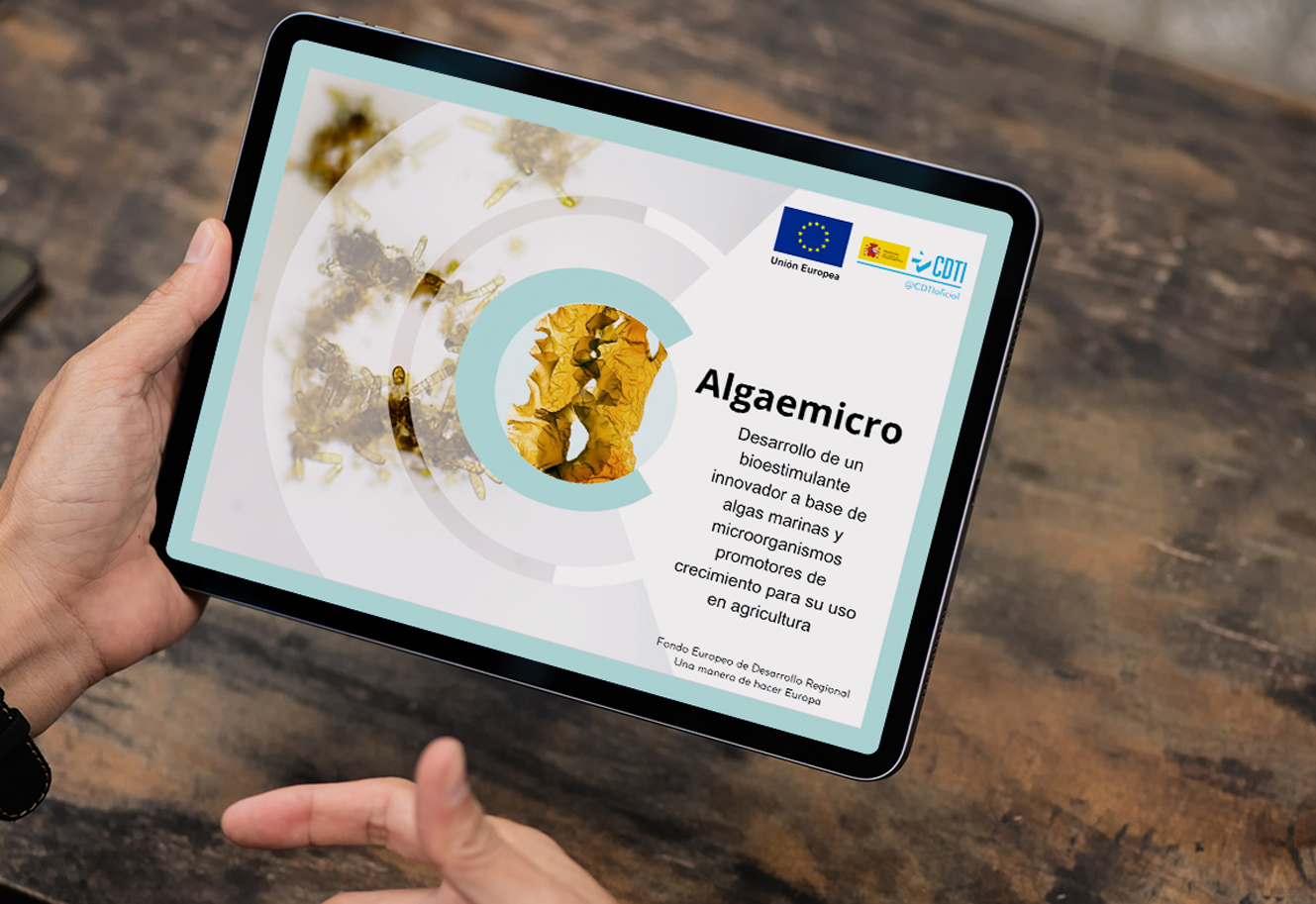
This proposal gave rise to the “ALGAEMICRO” project, aimed at developing unique technology that combines the benefits of macroalgae with microorganisms to provide agriculture with a more sustainable alternative to achieve productive objectives.
The main axis of the technology lies in the synergistic effect experienced by algae and microorganisms, i.e., the ability they mutually have to enhance their virtues, obtaining better results than if we used both independently.
Our raw materials, macroalgae, are an integral part of coastal marine ecosystems. It has been estimated that there are around 9,000 species of macroalgae classified into three main groups based on their pigmentation (e.g., Phaeophyta, Rhodophyta, and Chlorophyta). Brown algae are the second most abundant group, comprising about 2,000 species that reach their peak biomass levels on the rocky coasts of temperate zones. These are the most used in agriculture, and among them, Laminariales are used as biofertilizers in agriculture. The global use of macroalgae in the industry reached values of up to 6 billion dollars in 2004, mainly for the exploitation of alginates and other phycocolloids.
Meanwhile, the agricultural industry represents almost 50 million dollars in the use of fertilizers, biostimulants, and other additives, but only less than 1% corresponds to substances derived from algae.
So far, Ficosterra has developed three lines of certified organic products based on macroalgae extracts. These products act on soil, seeds, plants, and fruits, in an integrated fertilization approach that allows for the optimization of standard fertilization practices. This is achieved through a combination of mineral/chemical fertilizers N-P-K and other stimulants (biostimulants, amino acids, humic/fulvic acids, and phytosanitary products, among the most common).
Macroalgae extracts have been widely documented to present various components with high biological activity, playing a significant role as growth stimulants, enhancing yield, and increasing tolerance to biotic and abiotic stress in different types of plants. Thus, macroalgae extracts not only allow better nutrient utilization from the soil by the plant but also contribute to the gradual reduction of chemical fertilizers, thereby restoring the soil’s full agricultural productive potential. This has been proven in independent tests, where net total crop benefits have increased by 10% to 20%, depending on the crop and management type.
According to the type of methodology used in the extraction of macroalgae compounds, fertilizers (substances containing NPK nutrients, vitamins, and minerals) and various types of biostimulants (natural substances that promote growth without being nutrients, soil enhancers, or pesticides) can be obtained.
Ficosterra has managed to develop a new R&D project called ALGAEMICRO, which will be used to increase crop yields through the contribution of microorganisms and macroalgae components in soluble powder form.
The R&D challenges necessary to address this unique project funded by CDTI focus on the following aspects:
Production of a prebiotic from algae
that meets the following characteristics:
- Firstly, it must have a positive effect on the crop (either directly or indirectly) when applied individually in an agricultural field.
- Secondly, the biostimulant product, since it constitutes >90% of the dry matter of the final product, must be fully soluble to avoid potential clogs in agricultural systems and applications.
- Lastly, and ultimately the primary motivation for this raw material, it must provide a beneficial effect in growing the microbial colonies to be employed, enhancing the product’s efficiency without increasing production costs.
Production of a probiotic based
primarily on three microbial strains that act on specific nutritional aspects
of crops. These strains enhance both conventional and organic fertilization
plans and allow for more efficient use of nitrogen-based fertilizers and the
main macronutrients (NPK).
Verified synergy between the probiotic and prebiotic, as well as among the selected microbial strains. This required first verifying the effects of each element and then selecting those elements that demonstrated the highest internal compatibility.
The scientific-technological R&D challenge that Ficosterra has tackled with this project has been to develop its own technology combining the use of macroalgae from the Laminariaceae family and specific microbial consortia with MPB (Microbial Plant Biostimulants) effect, resulting in a new range of cutting-edge products in the agricultural sector.
The project has successfully scaled production and has been validated by the Chemical, Environmental, and Bioprocess Engineering Research Group (IQUIMAB) of the University of León and in various field tests.